 For any question call us at







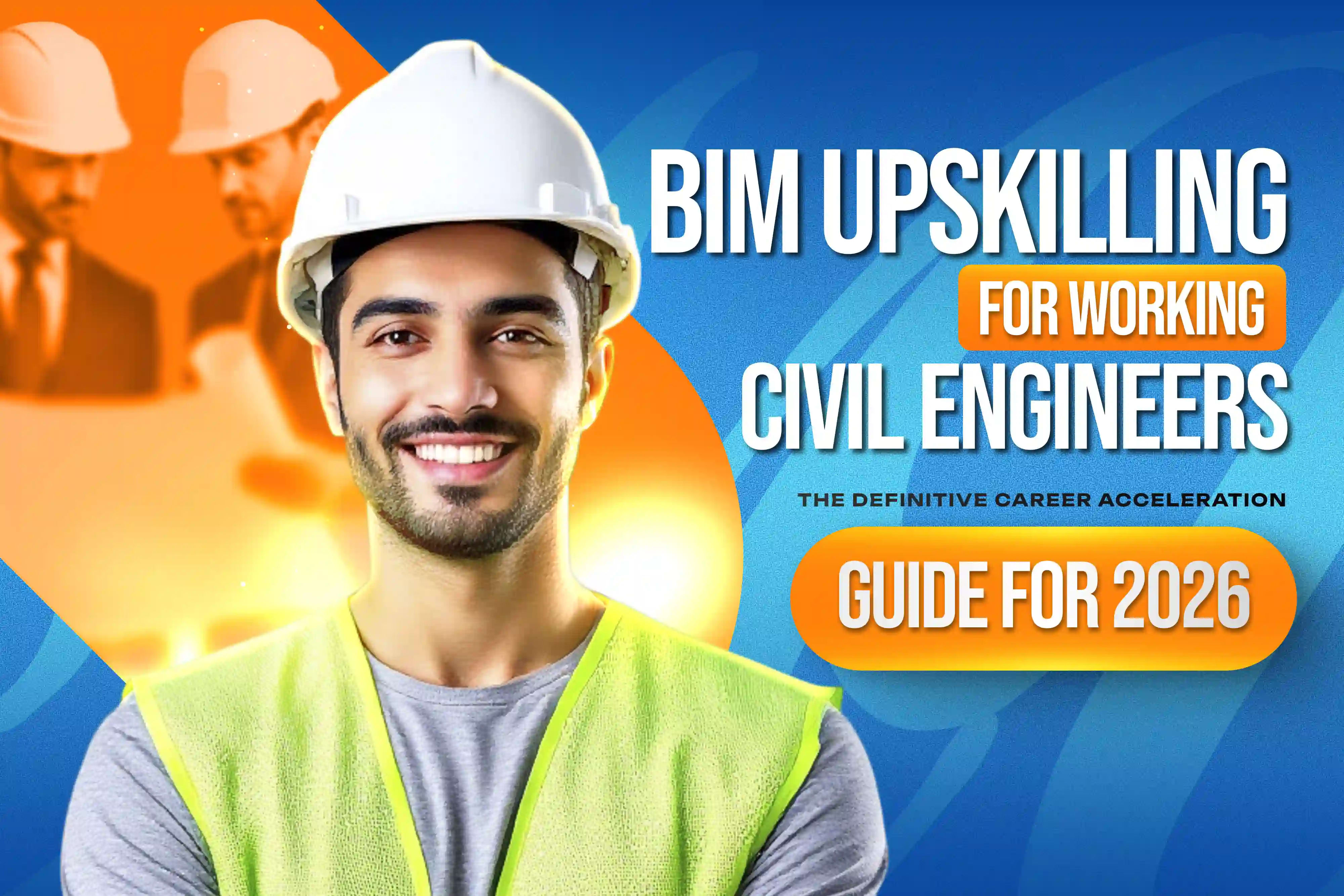
BIM Upskilling for Working Civil Engineers: The Definitive Career Acceleration Guide for 2026
The Career Inflection Point Every Civil Engineer Eventually Reaches
- You have been in the industry for a few years. You understand how a building actually comes together — not the textbook version, but the messy, real version with contractor disputes, material delays, drawing revision storms, and client expectation management. You have earned this knowledge the hard way.
- And yet, something is not quite right. The salary increments have been modest. The promotions have been slower than you expected. Perhaps a colleague who is years younger than you — but who has BIM skills — just moved past you into a role you thought you were in line for. Or perhaps you attended a job interview for a position you were well-qualified for, only to find the job description included 'Revit proficiency required' as a non-negotiable.
- If any version of this story sounds familiar, this guide is for you. In 2026, Building Information Modelling is not an optional add-on for civil engineers with experience. It is the tool that unlocks the next chapter of your career — whether that chapter involves a promotion, a salary jump, a Gulf relocation, or the launch of your own BIM consultancy. 2026 Industry Benchmark: According to a Dodge Data & Analytics report, 81% of construction firms globally now require mid-level and senior civil engineers to have BIM proficiency. In India, this number is growing at 25% annually. Engineers who don't engage with BIM are being systematically excluded from the highest-value roles.
Section 1: The Market Has Changed — Understanding Why Experience Alone Is No Longer Enough
1.1 The Old Career Ladder Is Breaking Down
- For decades, civil engineering careers followed a predictable path: graduate, join a firm as a site engineer, accumulate experience, get promoted to project engineer, then project manager, and eventually senior management. Experience was the primary currency. This model worked because projects were designed and delivered using methods that did not change rapidly.
- But BIM has fundamentally disrupted this ladder. Firms that adopt BIM workflows reorganise their project teams around BIM-literate engineers. Project coordination happens digitally. Design reviews happen on models, not drawings. Clash detection is automated. Quantity estimation is model-driven. In these environments, a highly experienced engineer who cannot navigate a BIM model is disadvantaged compared to a less experienced one who can — because the workflow literally does not support the old way of working.
1.2 What Is Actually Happening in Tamil Nadu's Construction Market in 2026
- The construction and infrastructure sector in Tamil Nadu is undergoing a significant transformation. Several forces are converging simultaneously in 2026:
- The Chennai Metro Phase 2 (86.1 km expansion) is requiring BIM-based project delivery from all major contractors and consultants.
- Madurai Smart City Mission projects have begun incorporating BIM specifications into tender requirements.
- Commercial real estate developers — particularly in the Grade A segment — are mandating BIM from their design and project management consultants.
- Industrial and logistics projects driven by Tamil Nadu's manufacturing investment pipeline are increasingly specifying BIM-based delivery for faster, more predictable project timelines.
- Government housing projects under PMAY (Pradhan Mantri Awas Yojana) are beginning pilot BIM implementations in Tamil Nadu.
- Every one of these project categories needs BIM-capable civil engineers. The demand is not speculative — it is being written into project contracts and tender specifications today.
1.3 The Hidden Cost of Not Upskilling: A Career Trajectory Analysis
- The impact of not acquiring BIM skills is gradual but compounding. Consider two engineers: Rajan and Muthu, both with six years of civil engineering experience. Rajan completes a BIM + Revit course in early 2026. Muthu does not, planning to learn it 'later when the time is right.
|
Career Milestone |
Rajan (BIM-trained, 2026) |
Muthu (No BIM, waits) |
|
End of 2026 |
Promoted to BIM Coordinator; salary ₹65K/month |
Continues as Project Engineer; salary ₹38K/month |
|
2027 |
Leading BIM coordination on ₹80 crore project |
Still waiting for promotion approval |
|
2028 |
Gulf offer: AED 12,000/month; relocates |
Completes BIM course, starts from fresh training level |
|
2029 |
2 years Gulf experience; BIM Manager level |
1 year BIM experience; junior BIM coordinator |
|
2031 (5 years later) |
Total career earnings lead: ~₹40–60 lakhs ahead |
Trying to close the gap with 3 years less BIM experience |
- This is not a hypothetical scenario. It is a pattern playing out in the careers of civil engineers across Tamil Nadu today. The engineers who act in 2026 will have a five-year lead over those who wait until 2028.
Section 2: The Experienced Professional's Unique BIM Advantage
2.1 Why Your Experience Makes You a More Powerful BIM User Than Any Fresh Graduate
- Here is the insight that most working professionals miss: your years of site and project experience are not rendered irrelevant by BIM. They make you dramatically better at BIM than someone who has just learned the software. BIM is a tool for managing complexity. You already understand the complexity it is managing.
- When a fresh graduate models a structural element in Revit, they are executing a software function. When you model the same element, you understand the construction implications — how it will be built, what the site constraints are, how it connects to the procurement timeline, and what can go wrong if it clashes with the adjacent MEP system.... This contextual intelligence makes your BIM work qualitatively superior.
|
Your Existing Experience |
How BIM Amplifies It |
|
Site execution and construction sequencing |
4D BIM simulation: visualise and optimise construction sequence before breaking ground |
|
Material and contractor management |
5D BIM cost models: automate BOQ, track material quantities in real time |
|
Coordination with architects and consultants |
Multi-discipline BIM linking: coordinate all trades in one model, detect conflicts before site |
|
Client presentations and project reporting |
3D renders, walkthroughs, and visual dashboards that replace hard-to-read 2D drawings |
|
Understanding of RFI and change order impacts |
Change management in BIM: see the ripple effect of design changes across the entire model instantly |
|
Quality control and site inspection |
Point cloud and BIM comparison: verify as-built construction against the design model |
|
Project risk management |
Clash reports, spatial analysis, and 4D scheduling to identify risks before they become problems |
2.2 The Roles That Are Now Accessible to You — And Closed Without BIM
- Let us be direct about which high-value roles require BIM proficiency and are effectively inaccessible without it, regardless of your years of experience:
- BIM Coordinator: Responsible for managing BIM models across project disciplines. Entry salary ₹55,000–₹85,000/month in India.
- BIM Manager: Senior oversight of all BIM processes on major projects. Salary ₹12–22 LPA in India, AED 15,000–28,000 in Gulf.
- VDC (Virtual Design and Construction) Engineer: Leads digital project delivery. High demand in international construction firms.
- Digital Project Manager: Oversees project delivery using digital tools including BIM. A growing role in Tier-1 construction companies.
- BIM Consultant: Provides BIM strategy and implementation advice to construction firms. High-value freelance and firm-based opportunity.
- Technical Director (BIM): C-level adjacent role at design firms; requires BIM + deep project experience combination.
Section 3: BIM Curriculum for Experienced Professionals — What You Will Learn
- S2B School of Engineering's programme for working professionals is structured differently from student courses. It acknowledges that you already understand construction fundamentals and focuses your time on the BIM-specific skills that convert your experience into a digital superpower.
Module 1: BIM Strategy and Project Management Context
- Unlike student programmes, professionals begin with BIM in the project management context — because that is where you live professionally.
- 12. BIM standards and mandate frameworks: ISO 19650, UK BIM Level 2, RERA BIM implications in India
- 13. BIM Execution Plan (BEP) creation: leading your project team's BIM adoption
- 14. Common Data Environment (CDE) setup and management: tools like Autodesk Construction Cloud, BIM 360, and Procore
- 15. BIM roles and responsibilities: understanding the full BIM project team structure
- 16. BIM procurement: how to specify BIM requirements in tenders and evaluate BIM submissions
- 17. Employer's Information Requirements (EIR): writing and reviewing BIM deliverable requirements
Module 2: Advanced Revit for Structural and Civil Applications
- 12. Accelerated Revit fundamentals: interface, navigation, and core tools (compressed for professional learners)
- 13. Structural modelling: columns, beams, slabs, foundations, connections, and rebar placement
- 14.... Families and parametric modelling: creating and modifying custom structural and civil families
- 15. Site modelling: topography, grading, cut/fill analysis, roads, and drainage elements
- 16. Infrastructure modelling basics: using Revit for bridge components, retaining walls, and civil structures
- 17. Revit for existing building documentation: scan-to-BIM workflows for renovation and refurbishment projects
Module 3: 4D BIM — Time and Schedule Integration
- This module is particularly valuable for experienced project managers and engineers who already understand scheduling.
- 14. Linking Revit models to MS Project and Primavera P6 schedules
- 15. 4D simulation: animating construction sequences to visualise project phases
- 16. Schedule-based clash and resource conflict identification
- 17. Using 4D BIM for progress monitoring and as-built recording
- 18. Presenting 4D simulations to clients and stakeholders
Module 4: 5D BIM — Cost Management Integration
- 8. Automated quantity takeoff from BIM models: accuracy, limitations, and best practices
- 9. Bill of Quantities (BOQ) generation directly from Revit model data
- 10. Cost database integration: linking model quantities to rate schedules
- 11. Change order impact analysis: how design changes propagate to cost automatically
- 12. 5D BIM for value engineering: identifying cost-saving opportunities at design stage
Module 5: Clash Detection and Coordination — Advanced Level
- 18. Advanced Navisworks: full clash matrix management across all disciplines
- 19. Tolerance-based clash rules: distinguishing actionable from non-actionable clashes
- 20. Issue tracking and RFI management through BIM coordination tools
- 21. Coordination meeting facilitation using model-based review sessions
- 22. Field coordination: linking BIM coordination data to site inspection workflows
Module 6: BIM for Facility Management and Asset Lifecycle
- 18. Understanding 7D BIM: how design-phase BIM data serves operations teams
- 19. As-built BIM model handover: preparing digital deliverables for facility management teams
- 20. COBie (Construction Operations Building Information Exchange): the data standard for FM handover
- 21. Integration with CMMS (Computerised Maintenance Management Systems)
- 22. O&M manuals and asset registers embedded in the BIM model
Module 7: Real Project Workshop — Leadership Focus
- For working professionals, the project workshop at S2B places you in a leadership scenario: you are the BIM Coordinator on a complex multi-discipline project. You set up the CDE, manage linked models from structural and MEP teams, run coordination meetings, produce clash reports, generate a BOQ, and prepare the final submission package. This replicates exactly the professional environment you will step into after the course.
Section 4: Career Transition Pathways — Real Scenarios for Working Engineers
Pathway A: Site Engineer → BIM Coordinator → BIM Manager
- This is the most common transition path for civil engineers with 3–7 years of site experience. The combination of real construction knowledge and BIM modelling skills is exactly what the
- BIM Coordinator role demands. Employers frequently state that they prefer BIM Coordinators who have site experience over pure software specialists because they understand constructability and can make pragmatic modelling decisions.
- Typical timeline after BIM certification: 3–6 months to first BIM Coordinator role, 2–3 years to BIM Manager level. This pathway can double your salary within 3 years.
Pathway B: Design Engineer → BIM Specialist → Gulf Opportunity
- Civil and structural design engineers with 2–5 years of experience in consultancies are among the most sought-after BIM candidates for Gulf-based roles. The combination of structural design knowledge and Revit proficiency is rare and highly compensated in UAE, Saudi Arabia, and Qatar. Gulf firms often pay AED 8,000–15,000/month for this profile — equivalent to ₹1.8–3.4 lakhs/month, a 4–6x uplift versus domestic design salaries.
- After completing BIM training, design engineers typically need 6–12 months of BIM project work in India before being competitive for Gulf applications. S2B's placement network includes Gulf-based hiring partners.
Pathway C: Project Manager → Digital Project Manager → VDC Lead
- Experienced project managers (5–10 years) who acquire BIM skills position themselves for the rapidly growing Digital Project Management segment. These roles pay ₹18–35 LPA in India at Tier-1 construction groups. The key is demonstrating not just BIM modelling ability but BIM project governance — BEP writing, CDE management, and coordination leadership — which is exactly what S2B's professional programme focuses on.
Pathway D: Independent Professional → BIM Consultant
- For engineers who have built a strong professional reputation and client network, BIM certification opens the consultancy route. Small and medium construction firms need BIM compliance for tender eligibility but cannot afford a full-time BIM team. A BIM consultant who can provide model creation, clash detection, and BIM coordination services on a project basis can charge ₹800–2,500 per hour or ₹2–8 lakhs per project.... This is a genuinely viable business model in Tamil Nadu in 2026.
Section 5: Financial Analysis — Complete ROI for Working Professionals
5.1 Salary Benchmarks for BIM-Trained Professionals (India + Gulf, 2026)
- Role India (Monthly) Gulf (Monthly) Junior BIM Technician ₹24,000 – ₹40,000 AED 4,000 – 7,000 BIM Coordinator ₹55,000 – ₹85,000 AED 8,000 – 14,000 BIM Manager ₹1,00,000 – ₹1,80,000 AED 15,000 – 28,000 VDC Engineer ₹80,000 – ₹1,40,000 AED 12,000 – 22,000 BIM Consultant (per project) ₹2L – ₹8L per project AED 25,000 – 80,000 per project
- Digital Project Manager ₹1,50,000 – ₹2,90,000 AED 20,000 – 40,000
5.2 A 10-Year Career Earnings Projection
|
Year |
Without BIM (Typical Growth) |
With BIM Certification (Conservative) |
|
Year 1 |
₹4.8 – ₹6 LPA |
₹7.2 – ₹12 LPA |
|
Year 2 |
₹5.4 – ₹7 LPA |
₹9 – ₹16 LPA |
|
Year 3 |
₹6 – ₹8 LPA |
₹12 – ₹20 LPA |
|
Year 5 |
₹8 – ₹12 LPA |
₹18 – ₹30 LPA (or Gulf: ₹30–50 LPA) |
|
Year 10 |
₹14 – ₹20 LPA |
₹30 – ₹60+ LPA |
|
10-Year Cumulative |
Approx. ₹90L – ₹1.4 Crore |
Approx. ₹1.8 – ₹3.5 Crore |
Section 6: The Gulf Opportunity — A Detailed 2026 Overview
- The Gulf Cooperation Council construction market is one of the most lucrative destinations for Indian civil engineers, and BIM proficiency is the clearest pathway into it. Here is a 2026 snapshot of the Gulf opportunity for BIM-trained Indian engineers:
Saudi Arabia: Vision 2030 and NEOM
- Saudi Arabia's Vision 2030 programme represents the largest construction investment in modern history. NEOM alone — the futuristic mega-development in northwestern Saudi Arabia — has a stated investment of USD 500 billion and is designed entirely using BIM-based digital twin technology. The project has an ongoing need for BIM engineers across all disciplines, with Indian engineers making up a significant portion of the technical workforce.... Entry-level BIM roles start at SAR 5,000–8,000/month; mid-level roles reach SAR 12,000–20,000/month.
UAE: The Most BIM-Advanced Market in the Region
- The UAE — particularly Dubai and Abu Dhabi — has mandated BIM for government construction projects since 2021 and is the most mature BIM market in the GCC. Dubai Municipality's BIM requirements cover all developments above a certain size threshold. The UAE construction market continues to grow driven by Expo City Dubai's legacy development, Dubai Urban Master Plan 2040, and Abu Dhabi's Economic Vision 2030. UAE salaries for BIM-trained civil engineers typically range from AED 6,000 to AED 20,000/month depending on experience and role.
Qatar: Post-World Cup Infrastructure Development
- Qatar is in a second major infrastructure phase, developing further urban, transport, and hospitality infrastructure built on the foundation of the World Cup. BIM is embedded in Qatar's National Development Framework, and the country's construction market offers strong salaries: QAR 7,000–18,000/month for experienced BIM engineers. Gulf Application Tip: S2B School of Engineering maintains relationships with Gulf-based hiring partners and placement agencies. Students who complete the BIM programme and build a strong project portfolio are actively referred for Gulf opportunities as part of the institute's placement support service.
Section 7: Overcoming the Real Barriers — Honest Answers for Professionals
'I Have a Full-Time Job and a Family. How Can I Manage the Time?'
- This is the most legitimate concern working professionals raise. S2B School of Engineering offers weekend-only batches (Saturday and Sunday) specifically structured for working engineers. Most professionals complete the full programme in 10–14 weeks by attending these weekend sessions without taking any leave from work. The institute has refined its scheduling and teaching pace over 8 years specifically to accommodate the constraints of working professionals. You do not need to choose between your career and your family — the schedule is designed for both.
'I'm in My Mid-30s. Is It Too Late to Start Learning BIM?'
- Absolutely not. Many of S2B's most successful professional graduates completed their BIM training between ages 32 and 42. Several of them are now BIM Managers or are working in the Gulf. The combination of mature professional judgment, client management skills, and BIM technical expertise is not something that 25-year-olds can replicate. Your age and experience are assets in BIM roles at the management level, not liabilities.
'My Company Does Not Use BIM. What's the Point?'
- There are two answers to this. First: your current company is very likely to adopt BIM within the next 2–3 years, whether by client mandate, competitive pressure, or regulatory requirement. Being the person in your team who already understands BIM puts you in an extraordinary position — you become the internal BIM champion, and that visibility accelerates your promotion. Second: if your current company will never adopt BIM, that is a market signal about its growth trajectory. BIM-using firms are growing faster. Getting BIM-trained is also a move that prepares you to join one of these growing firms.
'I Tried Learning Revit Online by Myself. I Couldn't Keep Up.'
- This is extremely common. Revit has a genuine learning curve, and self-directed online learning suffers from two problems: there is no structured progression, and there is no one to answer your questions when you get stuck. At S2B, you have trained faculty who can immediately resolve your confusion, a peer learning environment with other professionals at similar experience levels, and a structured curriculum that builds from fundamentals to advanced topics in a logical sequence. The in-person training environment dramatically accelerates learning compared to self-study.
'Will a Certificate from S2B Be Recognized by Employers?'
- Yes. S2B School of Engineering has 8 years of placement history in Tamil Nadu and beyond. Its graduates are working in firms across Madurai, Chennai, Coimbatore, Bengaluru, Mumbai, Dubai, and Riyadh. Employers who have hired S2B graduates know the quality of training. Beyond the institute's reputation, the portfolio of real project work you build during training is itself the most compelling credential — it shows employers what you can actually do, which is more persuasive than any certificate.
Section 8: Advanced Topics — Emerging BIM Technologies to Be Aware of in 2026
- The BIM landscape is evolving. As a working professional, staying aware of emerging trends positions you as a forward-thinking BIM professional rather than one who just knows the basics:
Digital Twins
- A digital twin is a real-time, continuously updated BIM model that mirrors the physical building or infrastructure during its operational phase. Using IoT sensors and data feeds, the digital twin reflects actual building performance — energy usage, structural health, occupancy patterns. This is the 7D BIM concept in operational reality. Engineers who understand digital twin principles are increasingly valuable in the facility management and smart infrastructure sectors.
Generative Design and AI in BIM
- Autodesk and other BIM platform developers are integrating generative design tools that use algorithms to automatically explore thousands of design options and identify optimal solutions based on engineer-defined parameters (cost, structural efficiency, material use). Civil engineers who understand how to set up and interpret generative design outputs will work more efficiently and produce better projects.
Point Cloud to BIM (Scan-to-BIM)
- Using LiDAR scanners to capture as-built conditions and converting that point cloud data into a precise BIM model is a growing service in renovation, retrofitting, and heritage building projects. Scan-to-BIM specialists are in high demand and command premium rates. S2B's curriculum introduces this technology as part of the advanced module.
GIS and BIM Integration
- Infrastructure projects — roads, bridges, utilities, drainage, and urban planning — require the integration of BIM with Geographic Information Systems (GIS). Platforms like Autodesk Civil 3D and Infraworks bridge this gap. Civil engineers working in infrastructure rather than building projects should understand GIS-BIM integration, which is increasingly specified in infrastructure tenders.
Section 9: Why S2B School of Engineering Is the Right Choice for Working Professionals
- There are several BIM training options available in Tamil Nadu.... Here is why S2B School of Engineering stands out specifically for working professionals:
|
S2B Advantage |
Why It Matters for You |
|
Founded by Sabari Construction professionals |
You learn from people who have managed real construction projects — not just academics |
|
8+ years of training track record |
Curriculum refined through thousands of student outcomes, not theoretical design |
|
25+ active hiring partners |
Real placement connections, not a list of company logos on a brochure |
|
99% placement record |
Verifiable outcomes from working engineers and students across Tamil Nadu and Gulf |
|
Weekend and evening batches |
No disruption to your current job — training fits around your life |
|
Small batch sizes |
Personalized attention; no 50-person lecture halls where you get lost |
|
Live project workshops |
Portfolio-building experience that is immediately demonstrable to employers |
|
Gulf placement support |
Active referral network for Gulf-based opportunities for eligible graduates |
Conclusion: 2026 Is Your Year. Act on It.
- You chose civil engineering because you wanted to build things — real, lasting things that matter. That instinct was right. But the tools used to build those things have changed, and the most important tool of 2026 is not a concrete mix or a theodolite. It is Building Information Modelling.
- You already have the foundation: project knowledge, construction understanding, client management experience, and professional judgment that no fresh graduate can match. What you are missing is the digital capability that transforms that foundation into a 21st-century engineering career. BIM training bridges that gap — efficiently, practically, and with a proven track record of career outcomes.
- The engineers who will lead Tamil Nadu's and India's next generation of infrastructure projects — the metro rails, the smart cities, the Gulf megaprojects — will be those who combined experience with digital mastery. That combination starts with one decision: enrolling in a BIM course.
- S2B School of Engineering in Madurai is ready for you. The batch schedule accommodates your work life. The curriculum is designed for professionals with real experience. The placement network is active and verified. And the career transformation waiting on the other side is real. S2B School of Engineering, Madurai — Trusted by Working Professionals Across Tamil Nadu and the Gulf for 8+ Years. 30+ Engineering Courses | 25+ Hiring Partners | 99% Placement Record. Your BIM career starts here.