 For any question call us at






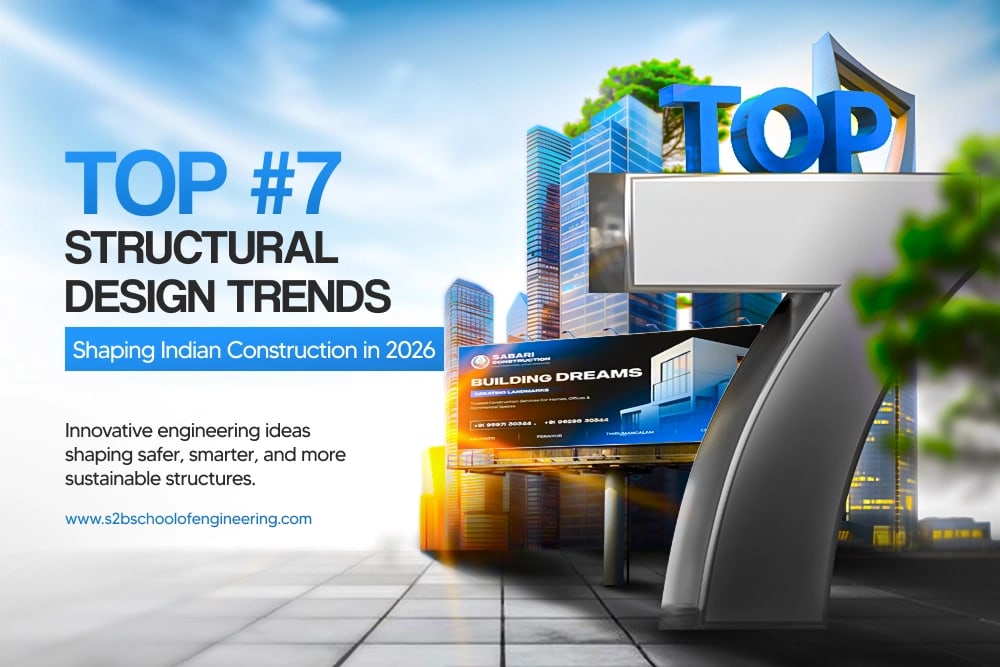
Top 7 Structural Design Trends Shaping Indian Construction in 2026
The Indian construction landscape is undergoing a radical transformation. Driven by rapid urbanization, climate urgency, and technological disruption, the way we design and build our cities is evolving at an unprecedented pace. For engineers, architects, and builders, staying ahead isn't just an advantage, it's a necessity. As we look toward 2026, certain structural design trends are moving from niche innovation to mainstream practice, fundamentally reshaping projects from high-rise commercial towers in Chennai to sustainable townships in Pune.
At S2B School of Engineering, we are at the forefront of integrating these advanced practices into our curriculum, ensuring our students are industry-ready. For professionals at firms like Sabari Constructions, adopting these trends is key to delivering projects that are resilient, efficient, and future-proof. Let's explore the top 7 structural design trends that will shape Indian construction in 2026.
1. Deep BIM Integration: From 3D Modelling to 7D Lifecycle Management
Building Information Modeling (BIM) is no longer just about creating pretty 3D renders. By 2026, deep BIM integration will be the backbone of all major projects, moving to 5D (cost), 6D (sustainability), and even 7D (facility management) applications.
- Why It's a Game-Changer: For Indian projects, this means faster statutory approvals from municipal corporations (as seen with initiatives like the Unified Building Bye-Laws), significant reductions in on-site clashes (saving up to 15-20% in rework costs), and seamless collaboration between structural, MEP, and architectural teams.
- The Indian Context: The mandate for BIM in large public infrastructure projects is already a reality. Private developers are following suit to manage complex commercial builds. Tools like Autodesk Revit and Navisworks are being used not only for design, but also for creating digital twins that aid in asset management long after construction is complete.
- Case in Point: The upcoming Mumbai Coastal Road Project extensively uses BIM for clash detection and structural simulation, a precursor to what will become standard.
2. Sustainable & Circular Structural Systems
Sustainability is transitioning from a feature to a foundational design principle. The focus is on reducing embodied carbon the carbon dioxide emitted during material manufacturing and construction.
- Low-Carbon Concrete: Expect wider use of Fly Ash-based concrete (PPC), GGBS concrete, and geopolymer concrete. These alternatives to traditional OPC cement can reduce the carbon footprint of a structure by 40-70%.
- Adaptive Reuse & Design for Deconstruction: Instead of demolition, structural engineers are designing to strengthen and repurpose existing frames. New structures are being conceived with bolted connections and modular elements that can be disassembled and reused, aligning with circular economy principles (IS 456:2000 provisions for durability are key here).
- Material Innovation: Engineered Bamboo for low-rise structures and Carbon-Cure concrete (which sequesters CO2 during curing) will see increased pilot projects.
3. Performance-Based Seismic Design (PBSD) for High-Rises
As Indian metros soar higher, merely complying with the prescriptive IS 1893 (Part 1):2016 code is no longer enough for premium projects. Performance-Based Seismic Design (PBSD) is gaining traction.
- Beyond Code Minimum: PBSD involves sophisticated non-linear dynamic analysis to predict how a building will perform under specific earthquake levels. The goal is to ensure life safety for a major quake and minimal repairable damage for a more frequent, moderate quake.
- Tools & Techniques: This relies heavily on advanced software like ETABS and SAFE for detailed modeling of structural components' post-elastic behavior. It allows for the design of controlled rocking frames, viscous dampers, and base isolators—technologies that were once considered exotic.
4. Modular Prefabrication & Off-Site Construction
Addressing skilled labor shortages and demanding project timelines, off-site construction is becoming a strategic choice, not just a last resort.
- Precast Concrete & Pre-Engineered Buildings (PEB): The efficiency and quality control of factory-cast structural elements are undeniable. PEB trends in India are evolving towards more architectural finishes, allowing warehouses to also house office spaces with aesthetic appeal.
- Volumetric Modular Construction: Entire rooms or apartments (Modules) are fabricated with MEP, finishes, and fixtures installed, then simply assembled on-site. This method cuts construction time by up to 50% and is ideal for hotels, hospitals, and mass housing.
5. AI-Driven Generative Design & Optimization
Artificial Intelligence is moving from project management into the core design process. Generative design tools are the next frontier.
- How It Works: Engineers input design goals, constraints (loads, materials, codes like IS 800:2007), and parameters (cost, space). The AI algorithm then explores thousands of design permutations to propose optimized structural solutions that a human might never conceive.
- Software Integration: The 2026 versions of tools like ETABS and Robot Structural Analysis will have deeper AI plugins. This leads to material-efficient designs, like complex, organic lattice structures that use 20-30% less concrete and steel without compromising strength.
6. Climate-Resilient & Passive Design Structures
With increasing flood events in Chennai and Mumbai and cyclonic winds on the coasts, structures must be designed for specific climate threats.
- Flood Resilience: Elevated foundations, amphibious foundations (that float during floods), and the use of water-resistant materials will be incorporated in flood-prone zones like Tamil Nadu and Kerala.
- Wind & Heat Mitigation: Aerodynamic building forms to reduce wind loads, integrated shading devices as part of the structural system, and thermally efficient building envelopes reduce reliance on active cooling systems.
7. Integrated MEP-Structural Coordination from Day One
The era of the structural frame being designed in isolation is over. The most efficient buildings are those where Mechanical, Electrical, and Plumbing (MEP) systems are coordinated with the structure from the conceptual stage.
- Efficiency Gains: This integration allows for optimally sized ducts and shafts to be embedded within beams and slabs (through BIM coordination), reducing floor-to-floor height. This can save significant material in cladding and lead to more spatially efficient high-rises.
- The Collaborative Process: It requires structural engineers to work in tandem with MEP consultants using common data environments (CDEs) from the very first design charrette, ensuring no major conflicts arise during construction.
Comparison of Key Software Tools Driving These Trends
|
Software |
Primary Use |
Trend Association |
Best For |
|
Autodesk Revit + Dynamo |
BIM Modeling & Automation |
Deep BIM, MEP-Structural Coordination |
Integrated 3D design and documentation |
|
ETABS / SAFE |
Structural Analysis & Design |
PBSD, AI Generative Design |
High-rise buildings, complex seismic analysis |
|
Tekla Structures |
Detailed Detailing & Fabrication |
Modular Prefabrication, BIM |
Precast concrete and steel detailing |
|
Rhino + Grasshopper |
Parametric & Generative Design |
AI-Driven Design, Complex Forms |
Architecturally exposed structures, optimization |
FAQs: Structural Design Trends 2026
Q1: Are these trends relevant for small and medium-scale builders in India?
Absolutely. While large firms may adopt full-scale BIM and AI first, principles like sustainable concrete, basic prefabrication (e.g., precast lintels), and climate-resilient design are scalable and cost-effective for all project sizes.
Q2: What is the biggest barrier to adopting these trends in India?
The initial skill gap and cost of software/training. However, the long-term ROI in terms of saved time, reduced material wastage, and fewer defects far outweighs the initial investment. This is precisely why upskilling through institutes like S2B School of Engineering is critical.
Q3: How is the Indian regulatory environment supporting these trends?
Codes are evolving. The National Building Code (NBC) is being updated, and bodies like the BIS are increasingly referencing performance-based standards. Green building certifications (IGBC, GRIHA) also incentivize sustainable and efficient design practices.
Q4: Which trend will have the most immediate impact on project costs?
Deep BIM Integration and Modular Prefabrication. They directly reduce construction time, rework, and labor overheads, showing a measurable impact on the bottom line within a single project cycle.
Building the Future, Today
The structural design landscape of 2026 is one of convergence, where technology meets sustainability, and resilience meets efficiency. For Indian engineering firms and construction companies, embracing these trends is not about chasing the new, but about building smarter, safer, and more sustainable for the future.
The journey begins with knowledge. At S2B School of Engineering, our advanced diploma and certification programs are tailored to equip engineers with hands-on expertise in BIM, sustainable design, advanced seismic analysis, and more, directly aligning with the trends shaping tomorrow.
Ready to lead the next wave of Indian construction? Explore how our industry-aligned courses can empower your team. For firms like Sabari Constructions, investing in these skills today is the strongest foundation for the projects of 2026 and beyond.
Explore our : Advanced Diploma in BIM & Structural Design, Executive Diploma in Structural Design