 For any question call us at







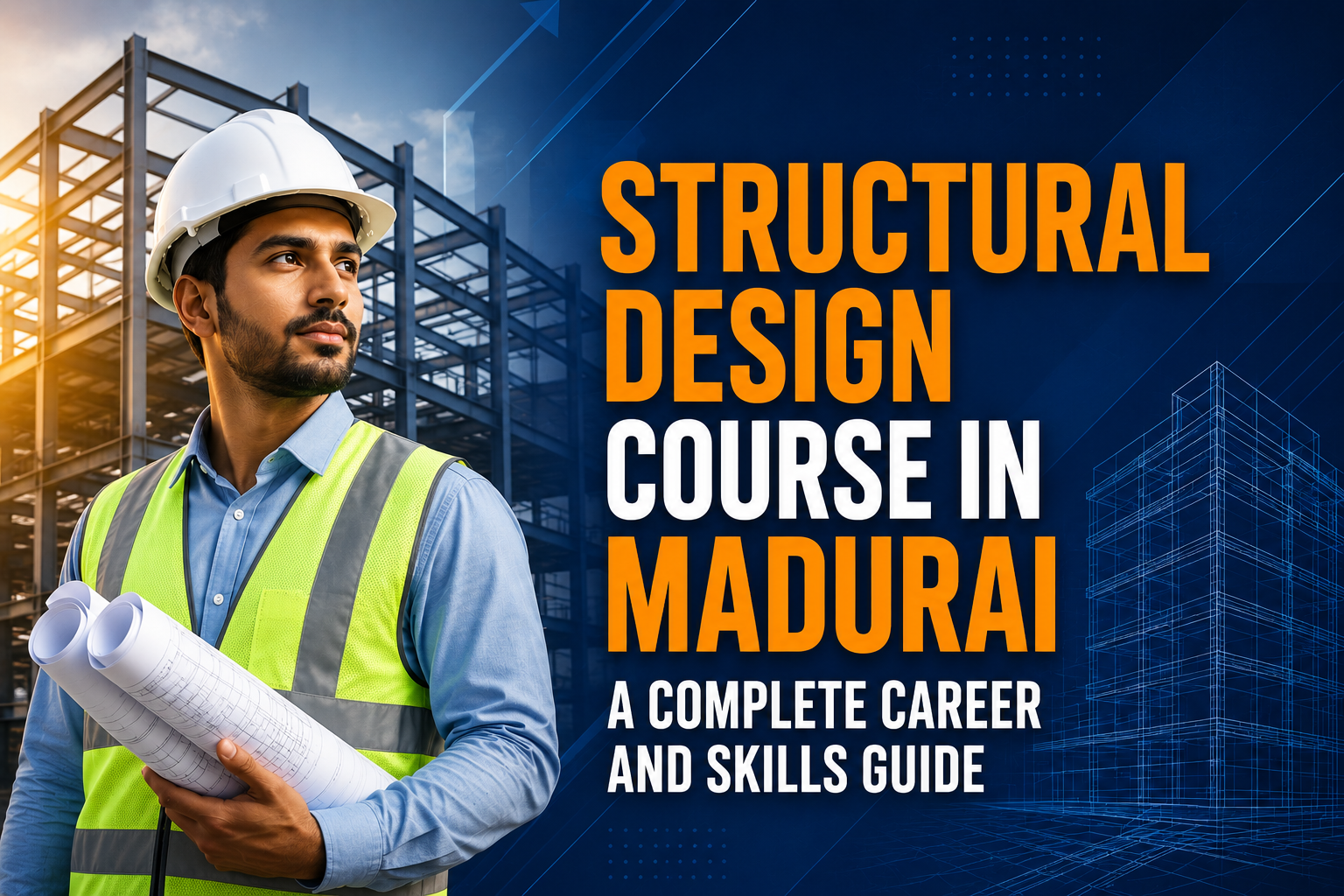
Structural Design Course in Madurai: A Complete Career and Skills Guide
Introduction
Every safe building stands because its structural design was done right. A well-designed beam carries load for decades; a poorly designed one cracks within seasons. For civil engineering students in Tamil Nadu, a structural design course in Madurai offers a direct route into a stable, well-paying career. This works best when the training builds real, job-ready skills, not just software familiarity. This guide covers what a genuine structural design training programme teaches, who it suits, the software involved, career paths, and salary expectations, so you can evaluate any course confidently before enrolling.
What is Structural Design?
Structural design is the process of sizing and detailing a building's beams, columns, slabs, and foundations so it safely carries every load throughout its life, including self-weight, occupants, wind, and seismic forces. A structural designer converts an architect's vision into a buildable, code-compliant structure. This needs strong knowledge of material behaviour, load calculations, and Indian Standard (IS) codes.
Key Takeaway: Structural design balances safety with economy, using engineering judgement backed by design software like STAAD Pro and ETABS.
Why is Structural Design Important?
Structural design matters because it directly controls a building's safety and construction cost. Over-designing wastes money; under-designing risks failure.This balance is why structural design remains one of the most respected specialisations in civil engineering and why demand for skilled engineers keeps growing across Madurai and South India. Most civil engineering degrees teach theory well but skip hands-on software modelling. That gap shows up in interviews, when candidates struggle to explain a basic column design. A focused structural design course in Madurai closes this gap by turning RCC and steel design theory into practical, demonstrable skill.
Who Should Join This Course?
This structural engineering course suits a wide range of learners, not just fresh graduates.
- Civil Engineering Students — want hands-on software exposure before entering the job market
- Diploma Students — build a practical, employable skillset through civil design training
- Graduates — have strong theory but limited real project experience
- Working Professionals — site or construction staff moving into design roles
- Site Engineers — need to interpret structural drawings and coordinate with design teams
- Career Switchers — architects or drafters adding structural analysis skills
Benefits of Learning Structural Design
Structural design training gives students a measurable edge in interviews and early career growth.
- Stronger interviews — real project work to discuss, not just academic scores
- Faster onboarding — less time spent training you on tools you already know
- Clear specialization — early exposure helps you choose design, drafting, or site execution
- A real portfolio — completed projects to show employers
- Better earning potential — software fluency speeds up salary growth in structural roles
Skills You Will Learn
A structural design course builds seven core capabilities that employers look for.
- Load calculation — applying dead, live, wind, and seismic loads correctly
- Structural modelling — representing geometry, supports, and connections in software
- RCC design — sizing and detailing beams, columns, slabs, and footings to code
- Steel design fundamentals — introduction to steel member design
- Foundation design — sizing footings based on soil bearing capacity
- Drawing and documentation — producing buildable structural drawings and reports
- Result interpretation — spotting modelling errors versus genuine structural issues
Software calculates fast, but it cannot judge whether an input assumption makes engineering sense. That judgement is what separates job-ready graduates from those who can only run a programme.
Software Covered
A structural design course in Madurai typically covers four industry-standard tools, each handling a different part of the workflow.
AutoCAD is used for 2D and 3D drafting and structural detailing. This AutoCAD structural course builds the working drawings contractors build from directly.
STAAD Pro is the core structural analysis course tool. STAAD Pro training in Madurai teaches students to calculate structural behaviour under real loads and produce code-compliant RCC and steel output.
ETABS training in Madurai extends this analysis for multi-storey and high-rise buildings, where lateral loads like wind and seismic forces are harder to model accurately.
Revit Structure training brings structural elements into a coordinated 3D BIM model, so structural teams work alongside architecture and MEP without design clashes.

Software Comparison Table
| Software | Purpose | Industry Usage | Difficulty Level | Career Scope |
|---|---|---|---|---|
| AutoCAD | 2D/3D drafting and structural detailing | Very high — near-universal requirement | Beginner-friendly | Draftsman, detailing engineer, site documentation |
| STAAD Pro | Structural analysis and design | High — standard across most design firms | Moderate | Structural design engineer, analysis specialist |
| ETABS | Analysis and design of multi-storey and high-rise structures | Growing, especially on large commercial projects | Moderate to advanced | High-rise structural designer, senior design roles |
| Revit Structure | 3D structural BIM modelling and coordination | Rising steadily as BIM adoption grows | Moderate | BIM coordinator, structural modeller, coordination lead |
The practical learning order is AutoCAD first, then STAAD Pro for core analysis. ETABS becomes relevant for taller buildings, and Revit Structure adds value once multi-discipline coordination enters the job.
Course Curriculum / Learning Process
A structured civil engineering training institute moves students through four clear stages before independent project work.
Module 1: Drafting and Documentation Fundamentals — AutoCAD interface, drawing standards, layers, dimensioning, and 2D structural drafting with reinforcement detailing.
Module 2: Structural Analysis Fundamentals — STAAD Pro basics, covering geometry creation, load application, and reading bending moment and shear force diagrams.
Module 3: RCC, Steel, and Foundation Design — beam, column, and slab design per IS codes, steel design basics, and foundation types (isolated, combined, raft).
Hands-on Practice — guided exercises on realistic structural scenarios before unsupervised project work.
Assignments — individual tasks like designing a beam or checking a foundation for a given soil condition.
Projects — a complete structural design package, from architectural drawings through analysis, design, and documentation.
Assessment — evaluates technical accuracy and code compliance so students can defend their design choices.
Certification follows successful completion and confirms both software proficiency and design capability.
Real-Time Projects
Real-time projects are the most valuable part of any structural design course, because they mirror actual job workflows.
Students take a complete design scenario from architectural layout through load application, analysis, member design, and final documentation, exactly as it happens on the job.
A structural engineer rarely works on one calculation in isolation. Graduates trained on live projects step into their first job already comfortable with the full workflow, instead of needing months to adjust.
Career Opportunities
This structural engineering course opens several career paths across Madurai's construction industry and beyond, depending on your strengths.
- Structural Design Engineer — modelling, analysis, and design at a consultancy or design firm
- Structural Draftsman — structural knowledge combined with drafting skill
- Site Engineer with Structural Understanding — interpreting drawings and coordinating with design teams
- BIM Coordinator with a Structural Focus — increasingly valuable as BIM adoption grows
- Structural Assessment and Retrofitting Specialist — evaluating existing buildings for renovation or seismic upgrades
Salary Comparison Table
| Job Role | Entry-Level Salary | Experienced Salary | Career Growth |
|---|---|---|---|
| Structural Design Engineer | ₹1.8L – ₹3L | ₹7L – ₹14L (5–10 yrs) | Strong — leads to senior and lead design roles |
| Structural Draftsman | ₹1.5L – ₹2.5L | ₹4L – ₹6L (5+ yrs) | Moderate — can progress into design or BIM roles |
| Site Engineer (Structural) | ₹2L – ₹3L | ₹5L – ₹8L (5+ yrs) | Steady — progresses toward project management |
| BIM Coordinator (Structural) | ₹2.5L – ₹4L | ₹8L – ₹12L (5+ yrs) | Strong — high demand as BIM adoption grows |
| Structural Assessment Specialist | ₹2L – ₹3.5L | ₹6L – ₹10L (5+ yrs) | Moderate to strong — specialised, growing niche |
Engineers who can independently run STAAD Pro or ETABS analysis earn at the higher end of each band. Pairing structural design with Revit Structure or BIM coordination skills is the fastest route to senior roles.
Industry Demand
Demand for skilled structural engineers is rising steadily across the construction industry in Madurai and greater Tamil Nadu.
Residential, commercial, and infrastructure projects continue to expand, and design firms often need engineers who can independently handle analysis software rather than relying entirely on senior staff.
Structural assessment work, evaluating older buildings for safety or seismic strengthening, is also growing. As BIM adoption spreads across larger projects, engineers who combine analysis software skills with BIM coordination stay well positioned for civil engineering jobs in Madurai and across South India.
Certification
A structural design certification alone doesn't guarantee a job, but paired with real project work, it strengthens your candidacy in two ways.
It proves you completed a structured curriculum, not scattered tutorials. And it gives you a concrete portfolio to reference in interviews, real work you designed, not just material you studied.
Choose a certification that is verifiable and recognised within the regional construction industry. Local hiring networks often matter more than a generic, unverifiable certificate for entry-level roles.
Why Choose S2B School of Engineering
S2B School of Engineering is a structural design institute in Madurai built around practical, project-first training.
- Industry Trainers — professionals with genuine structural and construction backgrounds, connected to Sabari Construction
- Practical Learning — real design work over passive software demonstrations
- Live Projects — complete structural design packages from architectural drawings to final documentation
- Placement Support in Madurai — guidance connected to hiring partners across the construction industry
- Updated Curriculum — AutoCAD, STAAD Pro, ETABS, and Revit Structure taught together
- Career Guidance — help identifying whether design, drafting, or site work suits you best
- Industry-Recognized Certification — verifiable proof of software and design capability
- Student Mentoring — ongoing support throughout the course, not a one-time onboarding
Frequently Asked Questions
What is structural design in civil engineering?
Structural design is the process of determining the size, shape, and material of structural elements like beams, columns, and foundations so a building can safely carry all expected loads throughout its life. It combines material science, load analysis, and IS code compliance to keep structures safe and cost-effective.
Is a structural design course useful alongside a civil engineering degree?
Yes. A degree builds theoretical grounding, while a focused structural design course adds practical software skills and real project experience. Most academic programmes don't cover hands-on modelling in STAAD Pro, ETABS, or Revit Structure in enough depth for job readiness.
Which software is taught in a structural design course?
Most courses cover AutoCAD for drafting and documentation, STAAD Pro for structural analysis and design, ETABS for high-rise structural analysis, and often Revit Structure for building information modelling (BIM). Together, these tools cover the full structural design workflow used in the industry.
How long does a structural design course typically take? Duration varies by institute and depth, but a comprehensive course covering drafting, analysis, design, and a real project usually takes a few months to complete properly. Courses that rush through software basics without real project work tend to leave graduates underprepared for interviews.
Can diploma holders join a structural design course?
Yes, diploma and polytechnic graduates are commonly accepted, particularly into executive diploma-style programmes that don't require a specific engineering degree background. These programmes focus on practical software and design skills rather than advanced theoretical prerequisites.
What career roles are available after completing structural design training?
Common roles include structural design engineer, structural draftsman, site engineer with structural understanding, and BIM coordinator with a structural design focus. Experienced professionals can also move into structural assessment and retrofitting work.
How is ETABS different from STAAD Pro?
STAAD Pro handles general structural analysis and design across a wide range of structure types, while ETABS is built specifically for multi-storey and high-rise buildings, particularly where complex lateral loads like wind and seismic forces are involved. Most engineers learn both for full career flexibility.
Conclusion
Structural design sits at the core of every safe, standing building and remains one of civil engineering's most dependable specialisations. A good structural design course doesn't just teach software. It builds the engineering judgement to use that software correctly, backed by real project work that turns theory into demonstrable skill. Whether you're a student, diploma holder, working professional, or career switcher, the path from structural theory to job-ready design capability is more accessible than it seems, provided the training at your chosen structural design course is genuinely practical.
Ready to move from structural theory to real, buildable design work? Explore the structural design course at S2B School of Engineering, Madurai. Book a free demo class, speak with the training team about a course plan suited to your background, and take the next step toward a genuinely job-ready structural engineering skillset.